Step Up Your HR
AI & Future of Work Resource Center for Employers
Practical AI guidance, trusted employer resources, and expert insights to help employers confidently step into the future of work.
━━━━━━━━━━
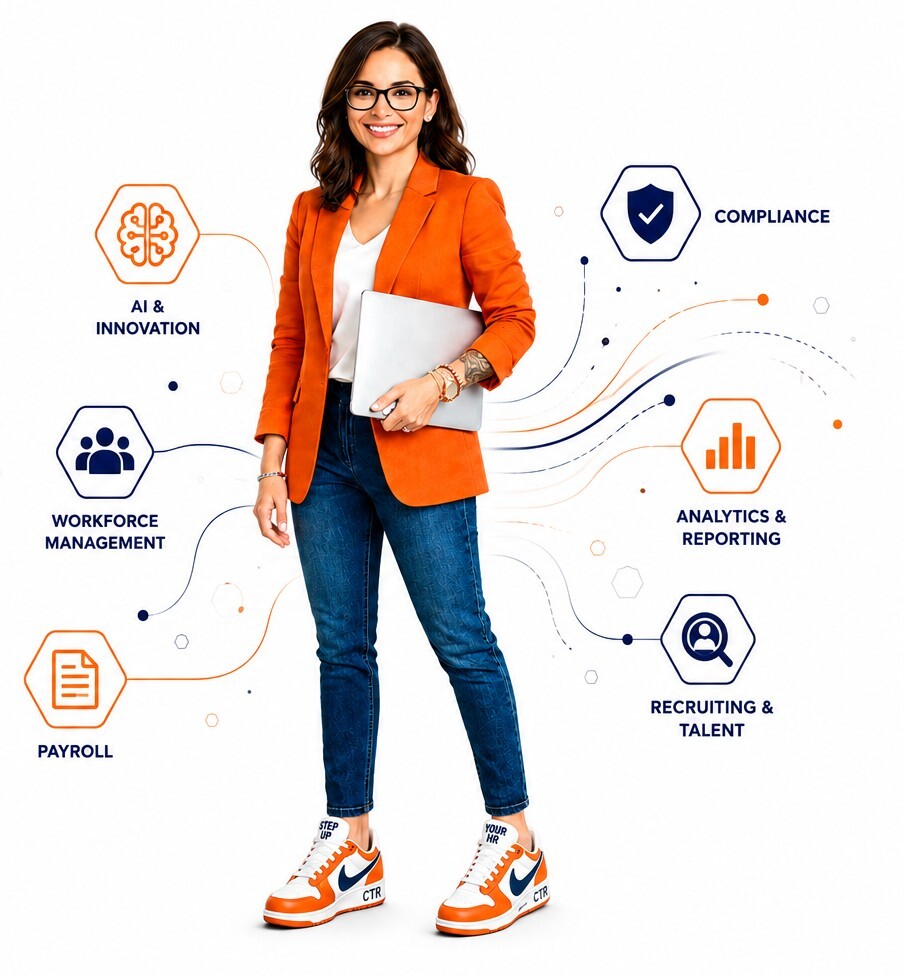
Artificial intelligence is transforming how organizations hire, manage, develop, and support their people. From HR and payroll to recruiting, compliance, employee experience, workforce management, and AI governance, employers are rapidly adopting AI to improve productivity and make better business decisions.
Last Updated: July 30, 2026
Start Your AI Journey
Every organization starts somewhere. Whether you're exploring AI for the first time, creating an AI workplace policy, or preparing your workforce for the future, these resources will help you confidently take the next step in AI, HR, payroll, compliance, and the future of work.
Assess Your AI Readiness
Measure your organization's AI readiness and identify your next steps. →
Webinar: AI, HR, and Compliance
Learn practical AI strategies for employers. →
Blog: AI in the Workplace
Understand the fundamentals of AI in the workplace. →
Get AI Answers
Get quick answers to the most common employer questions. →
How Employers Are Using AI Today
Increase Productivity
Reduce repetitive work and help employees focus on higher-value activities.
Improve Employee Experience
Provide faster answers, better self-service, and improved workplace support.
Prepare for the Future
Build an AI strategy that supports innovation while protecting your people and your organization.
Strengthen Compliance
Use AI to support policy development, improve consistency, reduce administrative burden, and help organizations navigate an evolving regulatory landscape.
Explore AI Topics
Browse practical employer resources by topic. Whether you're just getting started with AI or developing an organization-wide strategy, you'll find expert guidance tailored to today's workplace.
AI Basics
Learn the fundamentals of AI, common workplace applications, and how employers are using AI to improve productivity and decision-making.
Browse AI Basics →
HR & Compliance
Explore how AI is transforming recruiting, onboarding, employee communications, HR operations, and workplace compliance.
Explore HR & Compliance →
Payroll & Workforce Management
Discover how AI supports payroll, scheduling, workforce management, employee self-service, reporting, and operational efficiency.
View Payroll Resources →
AI Policies & Governance
Build a responsible AI strategy with guidance on workplace policies, governance, data privacy, security, and acceptable AI use.
Explore AI Governance →
Future of Work
Stay informed on emerging workplace trends, leadership strategies, workforce transformation, and the evolving role of AI.
Explore Future of Work →
Frequently Asked Questions
Get answers to common employer questions about AI in the workplace.
20+ employer questions answered below. →
What Is AI in the Workplace?
━━━━━━━━━━
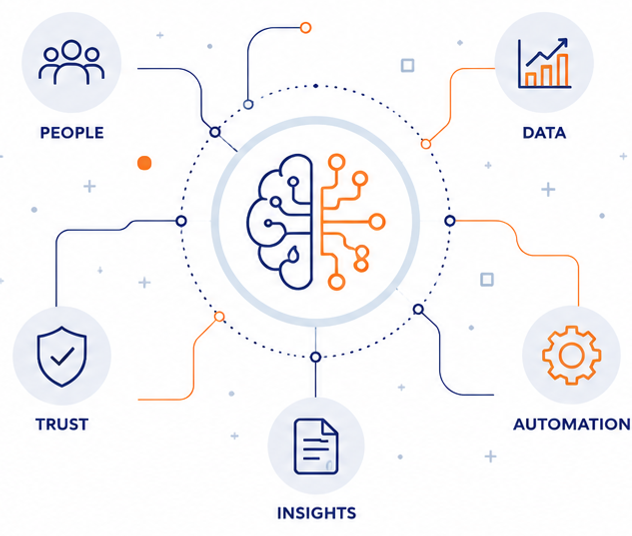
Artificial intelligence (AI) refers to technology that helps employees analyze information, automate repetitive work, generate content, and improve productivity.
Today, employers are using AI across HR, payroll, recruiting, employee communications, reporting, and workforce management.
As AI adoption accelerates, organizations should focus on responsible implementation, employee education, data protection, and governance.
The question is no longer whether AI will impact the workplace—it's how employers can use AI responsibly and effectively.
Common Examples of AI in the Workplace
Employee Self-Service
Employees can access information, complete tasks, and receive support through conversational technology.
Recruiting & Hiring
AI can help streamline candidate sourcing, scheduling, and administrative recruiting tasks.
Reporting & Analytics
Organizations can use AI to identify workforce trends and gain insights from data.
Productivity & Automation
Employees can automate routine tasks, summarize information, and improve efficiency.
Payroll Automation
AI can help reduce repetitive payroll tasks, improve efficiency, identify anomalies, and provide employees with faster access to payroll information through self-service tools.
AI Workplace Risks Employers Should Understand
As AI adoption increases, employers should evaluate potential risks and establish appropriate safeguards.
Data Security
Employees should understand what information may and may not be entered into AI tools.
Confidentiality
Sensitive company information, employee data, and proprietary information should be protected through clear policies and training.
Accuracy
AI-generated content should be reviewed by humans before being used for business decisions, employee communications, or compliance-related activities.
Governance
Organizations should establish expectations around acceptable use, approval processes, and accountability.
Employee Training
Employees need practical guidance on how to use AI responsibly and effectively.
Bias & Employment Decisions
AI should support—not replace—human judgment in hiring, promotions, performance management, or disciplinary decisions. Employers should evaluate AI-assisted decisions carefully to help promote fairness, consistency, and compliance.
Should Employers Have an AI Workplace Policy?
━━━━━━━━━━
For many organizations, the answer is yes.
As employee use of AI continues to grow, employers should consider establishing clear guidelines regarding:
- Acceptable use
- Confidential information
- Data privacy and security
- Human review requirements
- Employee responsibilities
- Ethical use considerations
- Workplace technology standards
An AI workplace policy can help reduce confusion, establish expectations, and support responsible adoption. Every organization is different. Your AI workplace policy should reflect your industry, workforce, data security requirements, and business objectives.
The Future of Work: Questions Employers Should Be Asking
━━━━━━━━━━
Technology is changing rapidly, but successful organizations are focusing on more than just tools. Employers should consider:
-
Do we know how employees are currently using AI?
-
Are managers prepared to lead through workplace change?
-
Have we established expectations for AI use?
-
Are we protecting company and employee data?
-
How can AI improve the employee experience?
-
What skills will employees need in the future?
-
How should AI fit into our overall business strategy?
The future of work starts with asking better questions.
AI Questions Employers Ask Most
Looking for quick answers? Below you'll find practical guidance to some of the most common questions employers ask about artificial intelligence, HR, payroll, compliance, workplace policies, and the future of work.
Artificial intelligence (AI) in the workplace refers to technologies that help employees and organizations complete tasks more efficiently. Employers use AI to automate repetitive work, analyze data, improve decision-making, generate content, enhance customer service, and support HR, payroll, recruiting, and workforce management.
Organizations are using AI to create job descriptions, draft employee communications, screen resumes, analyze workforce data, answer HR questions, automate administrative tasks, summarize meetings, improve reporting, and enhance employee self-service. Many employers are also using AI to increase productivity and improve the employee experience.
Yes. Every organization should have an AI workplace policy that establishes expectations for acceptable use, protects confidential information, defines employee responsibilities, and provides guidance for using AI responsibly. A clear policy helps reduce risk while encouraging innovation.
Potential risks include sharing confidential information, inaccurate or biased outputs, privacy concerns, cybersecurity threats, intellectual property issues, and regulatory compliance. Organizations should implement governance, employee training, and human oversight to help manage these risks.
AI helps HR teams automate repetitive administrative work, improve recruiting, support employee communications, streamline onboarding, analyze workforce trends, and provide employees with faster access to information. HR professionals remain essential for strategic leadership, compliance, employee relations, and decision-making.
AI can improve payroll reporting, workforce analytics, scheduling, forecasting, employee self-service, manager support, and operational efficiency. AI is designed to enhance payroll processes—not replace payroll professionals—and should always include appropriate oversight and validation.
Employees should never enter Social Security numbers, payroll records, employee personal information, protected health information, confidential financial data, passwords, trade secrets, client information, or proprietary business data into public AI platforms unless their organization has approved secure AI solutions.
AI governance is the framework organizations use to ensure AI is implemented responsibly, securely, ethically, and in compliance with company policies and applicable laws. AI governance typically includes policies, employee training, data protection, human oversight, accountability, and ongoing monitoring.
No. AI is changing how HR professionals work by automating repetitive tasks and improving efficiency, but it is not replacing the need for human judgment, leadership, compliance expertise, employee coaching, or workplace culture. AI is a tool that supports HR—not a replacement for it.
Employers should begin by identifying business goals, developing an AI strategy, creating an AI workplace policy, educating employees, selecting trusted AI tools, protecting confidential information, and establishing governance practices. A thoughtful implementation strategy helps organizations maximize the benefits of AI while minimizing risk.
The future of work refers to how technology, artificial intelligence, automation, workforce expectations, and evolving business practices are changing how organizations operate. Employers that embrace innovation while investing in people, leadership, and workplace culture are better positioned for long-term success.
AI can improve the employee experience by providing faster access to information, simplifying HR self-service, supporting learning and development, improving communication, reducing administrative work, and allowing employees to focus on higher-value activities.
Managers play a critical role in successful AI adoption by encouraging responsible use, supporting employee learning, reinforcing company policies, providing oversight, and helping teams identify practical opportunities to use AI effectively and ethically.
Responsible AI use begins with clear policies, employee education, data security, human oversight, transparency, and continuous evaluation. Organizations should ensure AI enhances productivity while protecting employees, customers, confidential information, and organizational values.
No. AI can automate repetitive payroll tasks, improve reporting, and answer common employee questions, but payroll professionals remain essential for compliance, tax regulations, problem-solving, audits, and ensuring payroll accuracy. AI is designed to support payroll teams—not replace them.
Organizations should provide employees with guidance on approved AI tools, acceptable use, data privacy, cybersecurity, prompt writing, AI limitations, and company policies. Ongoing training helps employees use AI confidently, responsibly, and securely.
The best AI tools depend on an organization's goals. Many employers are exploring AI capabilities within their existing HR and payroll platforms, such as the CTR's Connector for Claude (powered by isolved) along with productivity tools, meeting assistants, writing assistants, and workforce analytics solutions that integrate with existing business systems.
Yes. AI can introduce legal and compliance considerations related to hiring, employment decisions, data privacy, recordkeeping, intellectual property, and discrimination. Employers should review AI use carefully, establish governance policies, and stay informed as regulations continue to evolve.
Businesses can use AI to automate administrative work, improve customer service, streamline HR processes, enhance payroll operations, generate content, analyze data, and improve productivity without significantly increasing staffing costs. AI allows smaller organizations to work more efficiently while focusing employees on higher-value work.
More than a Provider. Your Irreplaceable Partner.
CTR makes payroll, HR & workforce management easier. With an all-in-one platform backed by personalized support, tenured experts, and customized solutions, you gain simplicity, compliance confidence, and more time to focus on your business.