Why Employees Quit in the First 90 Days and What Employers Are Doing Differently in 2026
Employers are spending a lot of time focused on recruiting right now. But many are quietly running into a different problem once employees actually start.
New hires are leaving fast.
In many cases, employees are deciding within the first few weeks whether they see themselves staying long term.
And surprisingly, it is often not one major issue driving the decision.
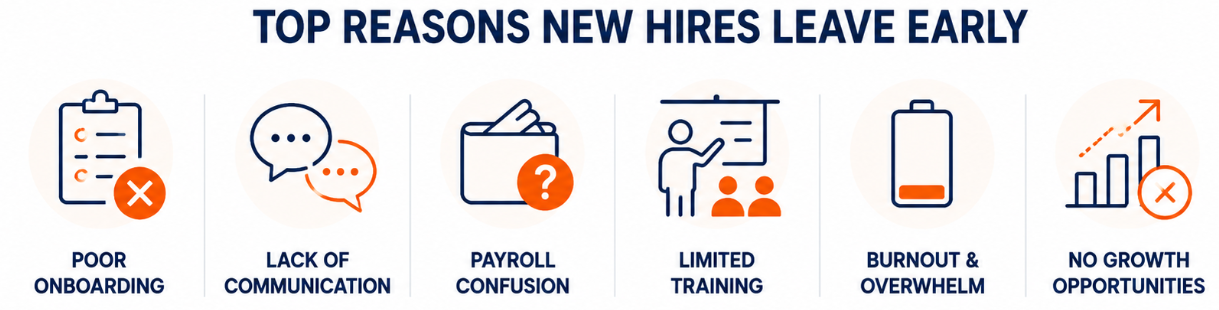
It is the accumulation of smaller frustrations:
- poor communication
- confusing onboarding
- delayed payroll setup
- lack of direction
- inconsistent training
- managers stretched too thin
- disconnected systems
- feeling ignored after day one
Employees notice disorganization immediately. If a new hire cannot access payroll, does not know who to contact, gets inconsistent answers, or spends their first week filling out paperwork instead of learning the job, frustration builds fast.
The first 90 days have become one of the most important periods for employee retention.
According to the Society for Human Resource Management (SHRM), organizations with structured onboarding processes are more likely to improve retention, employee engagement, and productivity.
Employees Decide Earlier Than Employers Think
Many employers still view onboarding as orientation paperwork, policy acknowledgements, and system setup.
Employees view it very differently.
To them, the first few weeks answer bigger questions:
- Is this company organized?
- Will I get support if I need help?
- Does communication here feel responsive?
- Are managers engaged?
- Do people seem overwhelmed?
- Is this going to make my life easier or harder?
Employees are evaluating the experience constantly, especially in environments where job opportunities remain competitive.
According to Gallup, employees who feel connected to their workplace and manager are significantly more engaged and more likely to stay.
What We’re Seeing Employers Struggle With Most
Most employers are not losing employees because of one catastrophic problem.
They are losing employees because small operational issues continue stacking up during the first few months:
- inconsistent onboarding experiences
- lack of communication between departments
- managers with limited time to train
- disconnected payroll and HR processes
- confusion around schedules, PTO, or benefits
- too many manual tasks
- delayed responses to employee questions
- unclear expectations after hiring
Many organizations are trying to manage these processes with good people, but outdated workflows.
That creates frustration for both employees and managers.
And employees today have less patience for disorganized experiences than they did even a few years ago.
Employees Expect More Than Orientation
Employees increasingly expect onboarding to feel organized, modern, and helpful from the beginning.
That does not mean employers need flashy programs or complicated processes.
But employees do expect:
- communication before day one
- clear expectations
- organized onboarding
- easy access to payroll and benefits information
- technology that works
- manager follow-up
- ongoing training and support
Research from Microsoft’s Work Trend Index continues to show that employees place a high value on communication, workplace experience, flexibility, and technology.
When those basics are missing, employees notice quickly.
Payroll and HR Experiences Impact Retention More Than Employers Realize
Many organizations underestimate how much payroll and HR processes shape the employee experience.
Employees interact with these systems constantly:
- payroll
- scheduling
- PTO requests
- onboarding paperwork
- benefits enrollment
- communication tools
- training systems
If those processes feel difficult, delayed, or confusing, employees often associate that frustration with the organization overall.
We are seeing more employers recognize that retention is not just a management issue anymore. Operational efficiency plays a major role too.
Sometimes retention problems start long before an employee formally resigns.
They start when employees feel unsupported, disconnected, or frustrated by daily processes.
What Strong Employers Are Doing Differently
The employers improving retention in 2026 are focusing less on “perfect onboarding” and more on creating a consistent employee experience.
That includes:
- communicating before day one
- creating structured onboarding plans
- simplifying payroll and HR processes
- giving managers better tools and visibility
- reducing manual administrative work
- checking in consistently during the first 90 days
- making training more accessible
- helping employees feel connected early
The goal is not simply completing orientation.
It is helping employees feel confident, informed, and supported.
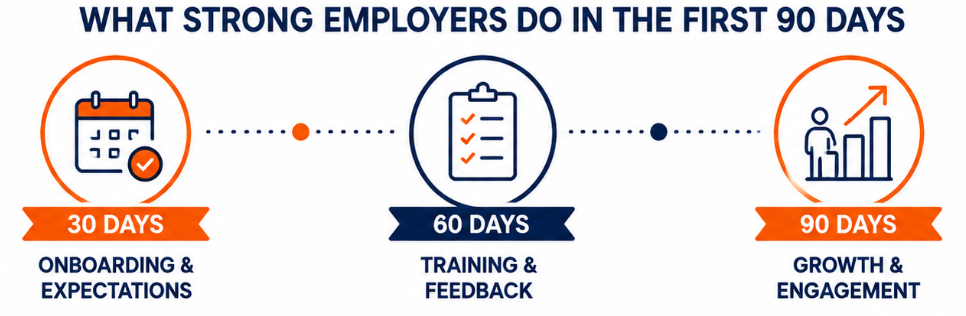
What Should Happen During the First 30, 60, and 90 Days?
First 30 Days
This is where first impressions are formed.
Employees should:
- understand expectations
- know where to go for help
- feel welcomed
- receive timely communication
- have payroll and benefits set up quickly
- gain access to systems and training
Days 31-60
This is where many employers unintentionally lose momentum.
Employees need:
- ongoing coaching
- manager interaction
- clear feedback
- additional training
- reinforcement around goals and expectations
Days 61-90
This is where engagement either strengthens or weakens.
Strong employers are:
- discussing growth opportunities
- reviewing performance expectations
- continuing communication
- addressing frustrations early
- helping employees feel invested long term
Warning Signs a New Hire May Leave
Early disengagement usually shows up before resignation.
Some common warning signs include:
- missed training sessions
- delayed communication
- attendance issues
- frustration with systems or processes
- limited participation
- lack of manager interaction
- disengagement during onboarding
- confusion around responsibilities
Catching these issues early often creates opportunities to improve the experience before turnover happens.
Frequently Asked Questions About Employee Retention
Why do employees quit in the first 90 days?
Employees often leave early when onboarding feels disorganized, communication is inconsistent, expectations are unclear, or daily processes create frustration. Many employees decide quickly whether an organization feels supportive and well-managed.
How can employers improve new hire retention?
Employers can improve retention by creating structured onboarding experiences, improving communication, simplifying payroll and HR processes, supporting managers, and maintaining regular check-ins throughout the first 90 days.
What should be included in a 30-60-90 day onboarding plan?
A strong onboarding plan should include training, manager communication, payroll and benefits setup, role expectations, employee feedback, performance discussions, and opportunities for employees to feel connected to the organization.
How does onboarding affect employee retention?
Onboarding shapes an employee’s first impression of the company. Disorganized onboarding often creates frustration early, while clear communication and structured support can improve engagement and long-term retention.
How can HR technology help reduce turnover?
HR technology can improve the employee experience by simplifying onboarding, improving communication, streamlining payroll and HR processes, supporting training, and reducing administrative frustration for both employees and managers.
Conclusion
Retention challenges often begin much earlier than employers think.
Employees are evaluating communication, responsiveness, organization, support, and workplace experience from day one.
The employers improving retention in 2026 are not necessarily the ones with the biggest budgets or the most complicated programs.
They are the organizations creating smoother experiences for employees and managers from the very beginning.
At CTR Payroll | HR, we help employers simplify onboarding, payroll, HR, workforce management, and employee experience processes through technology backed by dedicated expert support.
✴️Learn more about:
Disclaimer: This blog is for general informational purposes and is not legal advice.
---
Since 1964, CTR has been a trusted partner. As a Payroll & HR Partner, we offer a complete Human Capital Management (HCM) solution to help businesses manage employees from hire to retire. We provide award-winning software and expert, personalized service to automate and simplify every aspect of the employee life cycle: Payroll, HR, Benefits, Workforce Management, Talent Acquisition, Talent Management, Tax, Compliance, and more.
What sets us apart? Our Dedicated Support Rep Model-your dedicated rep will know you, your business, and provide fast, expert service. Our team includes Subject Matter Experts with over 20 years of experience, ensuring you receive guidance through even the most complex situations. 📍 Based in Pittsburgh, PA, CTR is a third-generation, family-owned company with over 60 years in the business. Our core values focus on being “All In,” relentless problem-solving, and exercising the basics better than anyone-principles that have fueled our success.
If you can’t say you LOVE your Payroll & HR provider, it’s time to Contact CTR! 🌐 https://ctrhcm.com/contact 📞 Reach us: (800) 468-2794 📧 Email: sales@ctrhcm.com
View our recent HR management & compliance webinars here: https://ctrhcm.com/resources/