

EEOC Chair Signals Potential Revisions to PWFA Protections for Infertility, Menopause & Related Conditions
 Background: The Pregnant Workers Fairness Act
The Pregnant Workers Fairness Act (PWFA), which took effect on June 27, 2023, requires covered employers to provide reasonable accommodations for known limitations related to pregnancy, childbirth, or related medical conditions — unless the accommodation would impose an undue hardship on the employer.
In April 2024, the EEOC published its final rule implementing the PWFA. Notably, the final rule adopted a broad interpretation of "related medical conditions," adopting a broad interpretation of “related medical conditions,” consistent with Title VII, which has been widely understood to include a range of reproductive and hormonal health conditions beyond pregnancy itself.
This broad reading drew criticism from some commissioners and industry groups at the time of publication, setting the stage for the current regulatory challenge.
Chair Lucas’s Position
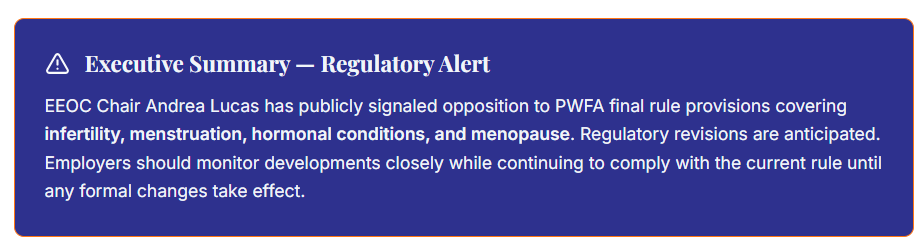
In public statements and on an official EEOC webpage, Acting Chair Andrea Lucas has reiterated her opposition to portions of the PWFA final rule and indicated that she intends to have the Commission reconsider certain provisions once it regains a quorum.
Specifically, Chair Lucas has argued that:
• The statute was intended to address accommodations for conditions directly arising from pregnancy and childbirth
• The EEOC’s interpretation of “related medical conditions” may extend beyond what Congress intended
• The regulation should be revisited to align more closely with a narrower, text-based reading of the law
These positions are consistent with her dissent during the April 2024 rulemaking process and signal a potential shift in how the EEOC may approach the scope of the PWFA moving forward.
Conditions at Issue
The following conditions, currently covered under the EEOC's final rule, are likely subject to revision or removal:
|
Infertility & Fertility Treatments Including IVF, IUI, and related diagnostic procedures. |
Menstruation & Menstrual Disorders Including dysmenorrhea, endometriosis, and PCOS-related symptoms |
|
Hormonal Conditions Conditions related to reproductive hormone imbalances |
Menopause & Perimenopause Including associated symptoms such as hot flashes, fatigue, and cognitive effects |
It is important to note that even if these conditions are removed from PWFA coverage, they may still be protected under the Americans with Disabilities Act (ADA), Title VII, or applicable state and local laws.
Potential Regulatory Changes
Although Chair Lucas has indicated an intent to revisit portions of the PWFA final rule, no formal rulemaking has been initiated at this time.
Any changes to the regulation would require a formal process under the Administrative Procedure Act, which typically includes:
• A Notice of Proposed Rulemaking (NPRM)
• A public comment period
• Issuance of a final rule
Until any revised rule is proposed and finalized, the current PWFA regulations remain in effect and legally binding.
Ongoing Legal Developments
The PWFA regulations are also facing challenges in the courts. In 2025, a federal court struck down a portion of the EEOC’s rule related to abortion accommodations, signaling that aspects of the regulation may continue to face judicial scrutiny.
This evolving legal landscape reinforces the importance of staying informed as both regulatory and court-driven changes unfold.
What Employers Should Do Now
Given the regulatory uncertainty, employers should take the following steps:
- Continue complying with the current PWFA regulations. Until a revised rule is finalized and effective, the existing rule governs employer obligations.
- Audit accommodation policies. Ensure that your organization's accommodation processes address all currently covered conditions, including those that may be subject to future revision.
- Monitor EEOC announcements. Subscribe to Federal Register updates and EEOC press releases for timely notice of any proposed rulemaking.
- Consult legal counsel. Work with employment law attorneys to assess how potential changes could affect your policies, particularly if you operate in states with laws that independently cover these conditions.
- Review state and local protections. Many jurisdictions provide coverage for fertility, menstrual, and menopausal conditions independent of federal law. Compliance with these laws will remain necessary regardless of federal changes.
- Document accommodation decisions carefully. Maintain thorough records of all accommodation requests and interactive process communications to demonstrate good-faith compliance.
The Bottom Line
The EEOC's anticipated regulatory revision does not change current employer obligations under the PWFA. The Chair's remarks signal a directional shift, not an immediate change in the law. Employers who proactively maintain robust accommodation processes and stay informed of regulatory developments will be best positioned to adapt as the landscape evolves.
✴️Need help with compliance? Contact CTR today!
Disclaimer: This blog is for general informational purposes and is not legal advice.
---
Since 1964, CTR has been a trusted partner. As a Payroll & HR Partner, we offer a complete Human Capital Management (HCM) solution to help businesses manage employees from hire to retire. We provide award-winning software and expert, personalized service to automate and simplify every aspect of the employee life cycle: Payroll, HR, Benefits, Workforce Management, Talent Acquisition, Talent Management, Tax, Compliance, and more.
What sets us apart? Our Dedicated Support Rep Model-your dedicated rep will know you, your business, and provide fast, expert service. Our team includes Subject Matter Experts with over 20 years of experience, ensuring you receive guidance through even the most complex situations. 📍 Based in Pittsburgh, PA, CTR is a third-generation, family-owned company with over 60 years in the business. Our core values focus on being “All In,” relentless problem-solving, and exercising the basics better than anyone-principles that have fueled our success.
If you can’t say you LOVE your Payroll & HR provider, it’s time to Contact CTR! 🌐 https://ctrhcm.com/contact 📞 Reach us: (800) 468-2794 📧 Email: sales@ctrhcm.com
View our recent HR management & compliance webinars here: https://ctrhcm.com/resources/